Comic 016 – The Pincode That Wasn’t a Number
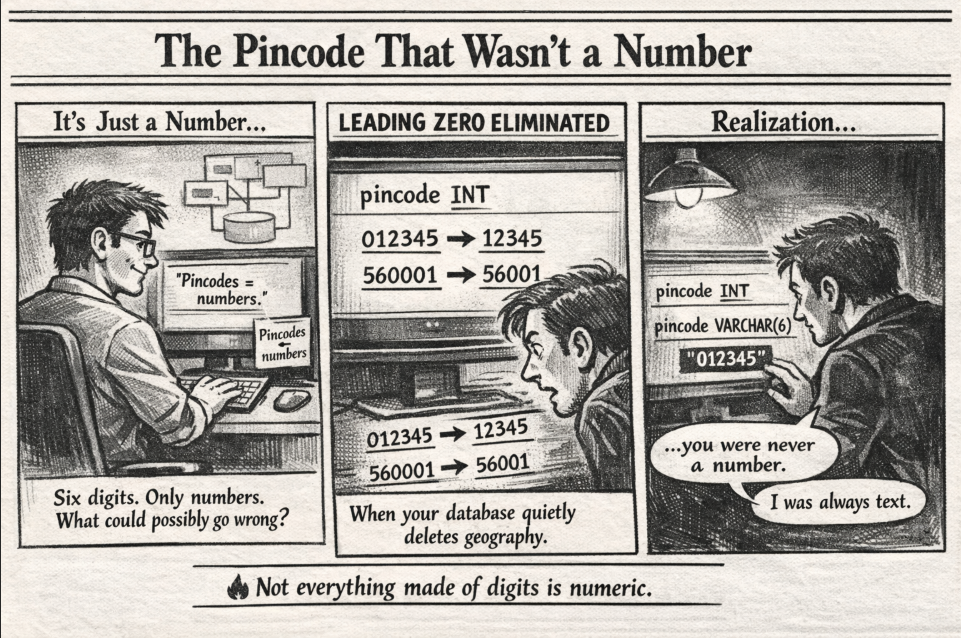 When six digits pretend to be a number but behave like identity data 📮
🧩 Problem
At first glance, a pincode looks like a number.
Six digits.
Only numeric characters.
Perfect candidate for INT in a database… right?
But here’s the catch:
👉 Pincodes are identifiers, not quantities.
So when stored as integers:
012345 → 12345
💥 Leading zeros disappear.
Suddenly your database silently changes real-world location data.
💻 Code Example (SQL)
Here’s the classic mistake:
CREATE TABLE address (
    id INT PRIMARY KEY,
    city VARCHAR(50),
    pincode INT
);
Looks harmless.
Until production data arrives:
012345 stored as 12345
Correct version:
CREATE TABLE address (
    id INT PRIMARY KEY,
    city VARCHAR(50),
    pincode VARCHAR(6)
);
Now:
"012345" stays "012345"
Exactly as intended ✅
🌍 Real-World Connection
This isn’t just about pincodes.
Many numeric-looking values are actually labels, not numbers:
- Pincodes
- Phone numbers
- Aadhaar numbers
- ZIP codes
- Product IDs
- Employee IDs
- Roll numbers
You never:
- add them
- subtract them
- multiply them
- average them
They exist to identify, not calculate.
Which means they belong in:
VARCHAR
—not—
INT
🛠 How It’s Solved in the Real World
Production systems treat identity-style numbers differently from mathematical numbers.
Here’s how engineers handle them correctly:
-
Store identifiers as text
Postal codes differ across countries:
India: 560001
USA: 02115
UK: SW1A 1AA
Only text supports all formats safely.
-
Preserve leading zeros
Example:
02115 ≠ 2115One missing zero = wrong location.
-
Avoid unintended transformations
Integer storage can:
- drop zeros
- reformat values
- break indexing logic
- corrupt imported datasets
-
Design globally compatible schemas
Production databases assume:
identifiers ≠ numbers
even if they look numeric.
⚡ Takeaway
Not everything made of digits is numeric.
Some values are meant to be calculated.
Others are meant to be remembered exactly as they are.
👉 Great engineers don’t just store data.
They store meaning.
📅 Published: April 2026 ✍️ Author: Aisha Karigar