Comic 013 – The Tech Stack Reality
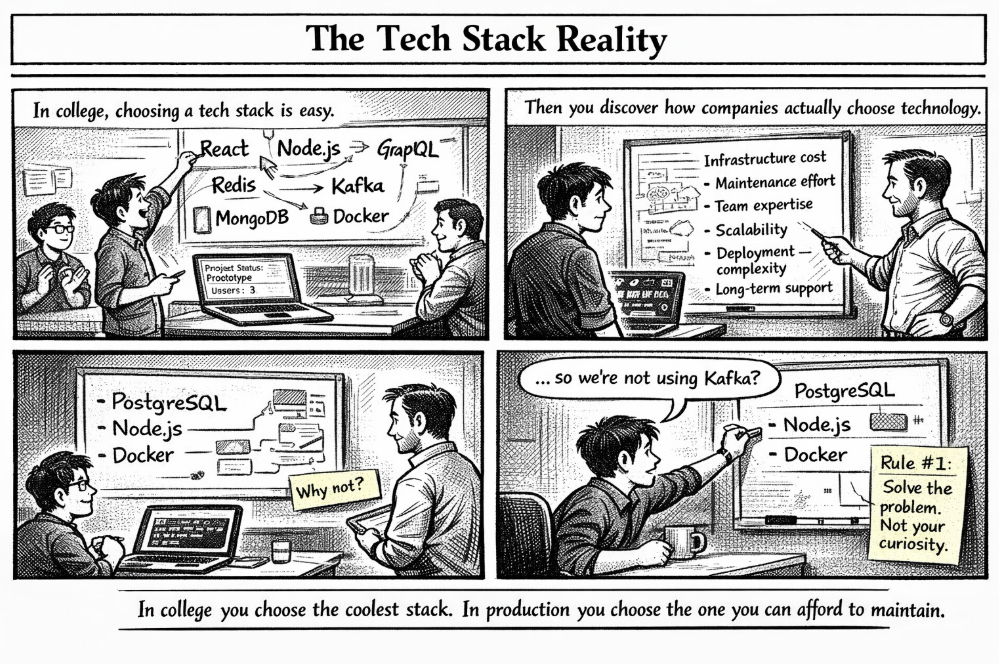 When your dream stack meets the company budget.
🧩 Problem
In college, choosing a tech stack feels like a creative playground.
You gather your teammates and start listing everything exciting:
👉 React
👉 Node.js
👉 GraphQL
👉 Redis
👉 Kafka
👉 MongoDB
👉 Docker
👉 Kubernetes
The goal is simple: build something cool and make it work.
But once you enter the industry, you quickly discover something important:
Technology decisions are not just technical decisions.
They are business decisions.
Companies don’t choose stacks based on what is trendy.
They choose them based on what they can maintain, scale, and afford.
💻 A Simple Example
Imagine building a notification system for an application.
In a college project, you might design something ambitious like this:
// Over-engineered student version

import Kafka from "kafka-node";
import Redis from "redis";
import express from "express";

const app = express();
const redisClient = Redis.createClient();

app.post("/notify", (req, res) => {
    const message = req.body.message;

    // Push event to Kafka
    kafkaProducer.send([{ topic: "notifications", messages: message }]);

    // Cache message
    redisClient.set("latest_notification", message);

    res.send("Notification queued");
});

app.listen(3000);
It works… but for a small application it might be overkill.
A production team might instead start with something much simpler:
// Practical production-first approach

import express from "express";

const app = express();

app.post("/notify", (req, res) => {
    const message = req.body.message;

    // Store notification directly in database
    saveNotification(message);

    res.send("Notification saved");
});

app.listen(3000);
Why?
Because the simpler system:
- is easier to deploy
- is easier to maintain
- reduces infrastructure cost
- allows faster development
If the system grows later, more components can always be added.
🌍 Real-World Connection
Engineering teams often evaluate technology choices using questions like:
- Does the team know this technology well?
- How much will this cost to run in the cloud?
- How hard will it be to maintain next year?
- Does this actually solve our problem?
For example, introducing Kafka into a system means managing:
- message brokers
- partitions
- monitoring clusters
- operational maintenance
If the application only has a few thousand users, the complexity might not be justified.
This is why many production systems start simple and evolve over time.
🛠 How Companies Actually Choose Tech
When selecting a stack, engineering teams typically consider:
Cost
Every service in the cloud costs money.
Adding more infrastructure increases:
- server costs
- storage costs
- monitoring costs
Team Expertise
A technology is only useful if the team understands it.
Using a complex stack without expertise can lead to:
- bugs
- slow development
- difficult debugging
Maintenance
Production systems live for years, not weeks.
Every component added today must be maintained tomorrow.
Scalability
Good architectures start simple but allow growth.
Instead of over-engineering early, teams often follow the rule:
Build for today, design for tomorrow.
⚡ Takeaway
One of the biggest lessons interns learn is this:
In college we often ask:
“What’s the coolest stack we can build with?”
In production, engineers ask:
“What’s the simplest stack that solves the problem?”
Because the best architecture isn’t the most complex one.
It’s the one your team can build, run, and maintain reliably.
📅 Published: March 2026 ✍️ Author: Aisha Karigar