Comic 012 – Welcome to Production
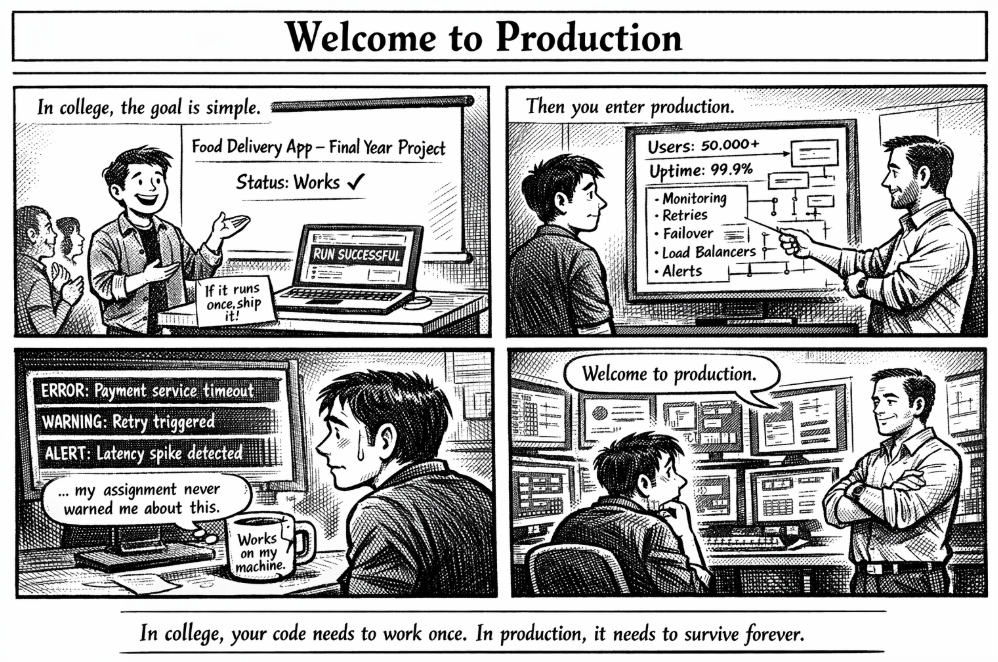 When “works on my machine” meets 50,000 users.
🧩 The Situation
In college, building software usually follows a simple rule:
👉 If the code runs once, the assignment is done.
You build the project, run it during the demo, the output appears…
and that’s enough.
But internships introduce a completely different reality.
Your code is no longer written for one demonstration.
It is written for real users, real traffic, and real consequences.
Suddenly the expectations change:
- The system must stay online 24/7
- Failures must be detected automatically
- Errors must be logged and monitored
- Systems must recover when things break
This is the moment many developers realize:
Software in production is not just code.
It is an ecosystem.
💻 A Simple Example
A college program might look like this:
#include <iostream>
using namespace std;

int main() {
    cout << "Food delivery service running..." << endl;
    return 0;
}
If the program runs and prints the message, the assignment is complete.
But a real service behind a food delivery platform might look more like this:
def handle_request(request):
    try:
        response = process_order(request)
        log_event("order_success")
        return response
    except TimeoutError:
        log_event("service_timeout")
        retry_request(request)
    except Exception as e:
        log_error(e)
        alert_engineering_team()
Now the system is responsible for:
- handling failures
- logging errors
- retrying operations
- alerting engineers
Because in production, failures are expected.
🌍 Real-World Connection
Consider a typical food delivery app.
When thousands of users place orders at the same time, the backend system must handle:
- huge traffic spikes
- network delays
- payment service failures
- database slowdowns
To survive this, companies design systems with layers such as:
- Load balancers to distribute traffic
- Monitoring dashboards to track system health
- Logging pipelines to investigate failures
- Alert systems to notify engineers instantly
Without these safeguards, even a small bug could bring down the entire service.
🛠 How Production Systems Handle This
Real-world software is designed with resilience in mind.
Monitoring
Engineers track metrics like:
- request latency
- error rates
- server health
This helps detect issues before users notice them.
Logging
Every system action can be recorded.
Logs help answer questions like:
- Why did a request fail?
- When did the problem start?
- Which service caused it?
Without logs, debugging production issues becomes nearly impossible.
Automatic Recovery
Instead of crashing when something fails, systems try to recover:
- retrying failed requests
- switching to backup services
- isolating faulty components
This allows platforms to maintain high uptime.
⚡ Takeaway
The biggest difference between college coding and production engineering isn’t syntax or frameworks.
It’s mindset.
In college we ask:
“Does the program run?”
In production we ask:
“Will the system survive?”
That shift in thinking is what turns a programmer into an engineer.
📅 Published: March 2026 ✍️ Author: Aisha Karigar