Comic 009 – The Single Point of Failure
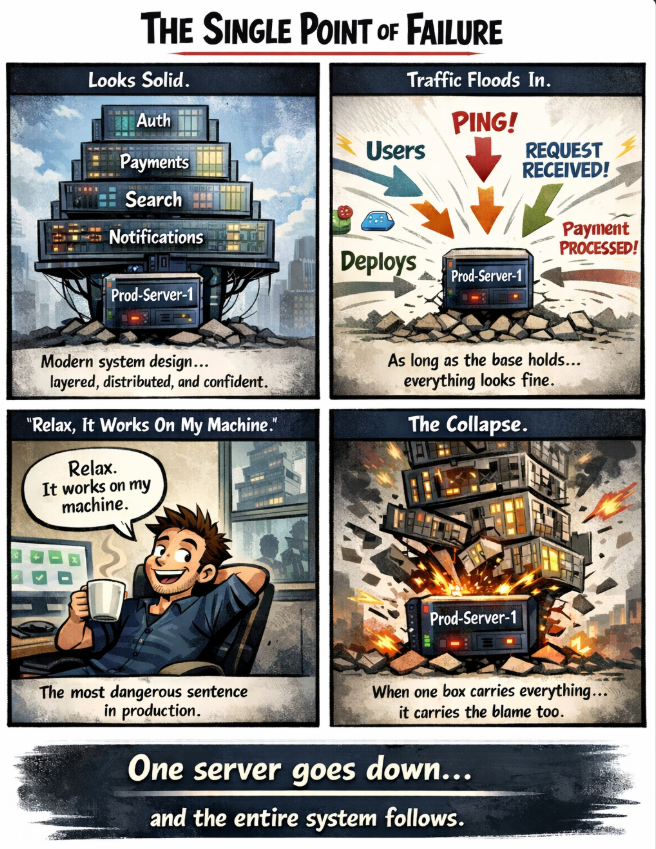
When your entire system stands on one shaky box 🧱💥
🧩 Problem
In system design, everything can look perfect on paper:
👉 Clean architecture
👉 Multiple services
👉 Green dashboards
But there’s one silent killer hiding underneath:
a Single Point of Failure (SPOF).
If one component goes down and the entire system collapses…
you didn’t build a distributed system —
you built a fragile one.
💻 Code Example (Conceptual – Single Server)
// A simplified representation of a single-server backend

Server prodServer("Prod-Server-1");

int main() {
    while (true) {
        Request req = receiveRequest();
        prodServer.handle(req); // everything goes here
    }
}
Looks simple. Works locally. Works in testing.
Until Prod-Server-1 goes down.
🌍 Real-World Connection
Imagine an e-commerce platform:
- User login
- Product search
- Payments
- Notifications
All routed through one backend server.
As traffic grows:
- CPU spikes
- Memory fills
- Latency increases
Then one bad deploy… 💥 The server crashes
Result:
- No logins
- No payments
- No orders
- No revenue
The business doesn’t degrade — it stops.
🛠 How It’s Solved in the Real World
Real production systems are designed to assume failure, not avoid it.
-
Redundancy Never rely on one instance. Use multiple servers running the same service.
-
Load Balancers Incoming traffic is distributed across healthy servers. If one fails, traffic is rerouted automatically.
-
Replication Databases are replicated across nodes. If the primary goes down, a replica takes over.
-
Health Checks & Auto-Healing Systems constantly check server health. Failed instances are removed and replaced automatically.
-
Failover Strategies Critical services have backups ready to take control within seconds.
In short:
Production systems are built to survive failure — not pretend it won’t happen.
⚡ Takeaway
System design isn’t about making things work. It’s about making sure they keep working when things break.
👉 If one server can take down your system, you don’t have high availability — you have false confidence.
📅 Published: September 2025 ✍️ Author: Aisha Karigar