Comic 008 – Infinite Loop Insanity
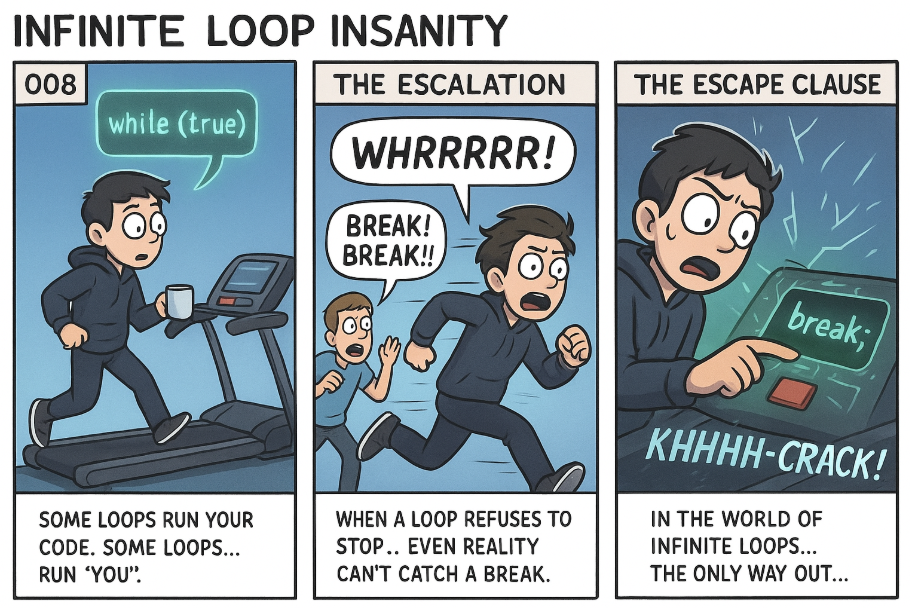 Some loops run your code. Some loops… run you. 🏃♂️💨
🧩 Problem
Infinite loops look innocent at first:
while (true) {
    // do something
}
But one missing exit condition…
One forgotten break…
💥
…and suddenly your program — or you — is running forever.
In real systems, infinite loops can freeze UIs, consume CPUs, stall servers, or take entire microservices down.
💻 Code Example (C++)
#include <iostream>
using namespace std;

int main() {
    int counter = 0;

    while (true) {
        cout << "Loop iteration: " << counter << endl;
        counter++;

        // Escape condition to avoid infinite loop
        if (counter == 5) {
            break;
        }
    }

    cout << "Loop exited successfully!" << endl;
    return 0;
}
🌍 Real-World Connection
Infinite loops aren’t just rookie mistakes — they appear everywhere:
- Frontend: A broken state update keeps re-rendering a UI.
- Backend: A
while(true)server worker hangs because a network response never arrives. - IoT systems: Sensors lock the whole device in a high-power loop.
- Game engines: AI logic loops tank the FPS to zero.
Worst-case scenario? ➡️ They max out your CPU and freeze the entire system.
Like the treadmill in the comic, the system keeps running… even when you can’t.
🛠 How Engineers Prevent Infinite Loops
To escape the “treadmill” in real-world systems:
✔️ Timeouts
Stop the loop if an operation takes too long.
✔️ Break Conditions
Always ensure a logical exit path.
✔️ Watchdogs (common in embedded systems)
If a loop stalls, an external monitor restarts the system.
✔️ Fail-Safes
“Should never happen” conditions must still have a fallback.
✔️ Resource Monitoring
Terminate loops that exceed CPU/memory limits.
Infinite loops aren’t just bugs — they’re architecture failures waiting to happen.
⚡ Takeaway
Every loop needs a way out.
Because in computing — and in life — a missing break can trap everything.
📅 Published: December 2025 ✍️ Author: Aisha Karigar