Comic 007 – The Boolean Who Lied
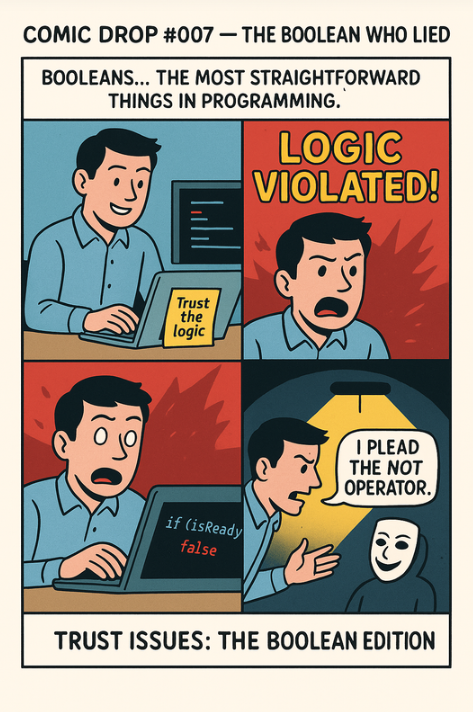
Trust issues: the Boolean edition 😵🔀
🧩 Problem
Booleans are supposed to be the most trustworthy things in programming:
👉 true means TRUE
👉 false means FALSE
No drama. No confusion. No loopholes.
But then one day… Your carefully crafted logic suddenly screams: “LOGIC VIOLATED!” 🔥
Your true behaves like false.
Your false behaves like true.
And you’re left interrogating your code like a detective in a crime thriller.
Welcome to… The Boolean Who Lied.
💻 Code Example (C++)
#include <iostream>
using namespace std;

bool trustIssue(bool val) {
    // Our Boolean is lying on purpose
    return !val; // The NOT operator — the perfect alibi
}

int main() {
    bool a = true;
    bool b = false;

    cout << "Original TRUE becomes: " << trustIssue(a) << endl;  // 0 (FALSE)
    cout << "Original FALSE becomes: " << trustIssue(b) << endl; // 1 (TRUE)

    if (trustIssue(true)) {
        cout << "Logic violated! This shouldn't run... but it does. 😐" << endl;
    }

    return 0;
}
🌍 Real-World Connection
A Boolean flipping unexpectedly is more than a quirky bug — it’s a logical betrayal.
In real systems, this can happen due to:
- ❌ Uninitialized or garbage memory
- ❌ Corrupted flags
- ❌ Race conditions
- ❌ Negated logic (
!isReadyvsisNotReady) - ❌ Faulty sensor readings
- ❌ Distributed systems where “truth” arrives late
One wrong truth value can trigger chaos:
- Running unsafe code paths
- Allowing unauthorized access
- Skipping validations
- Triggering alarms unnecessarily
- Breaking entire workflows
It’s the classic situation where your code says one thing… but reality says another.
🛠 How Engineers Prevent Boolean Betrayals
-
Always initialize flags Uninitialized booleans = unpredictable truth.
-
Use meaningful names Avoid nightmares like
!isNotReady. -
Assert invariants If a Boolean enters an impossible state → alert immediately.
-
Log unexpected flips When your Boolean “pleads the NOT operator,” you’ll know.
-
Reduce NOT overload Too many
!signs create Boolean spaghetti and hidden lies.
⚡ Takeaway
A Boolean only has two states… But if it lies even once, your entire program collapses like a house of cards.
So the next time you debug a strange behavior, don’t just check the logic. Check the liar hiding behind the logic.
Because in programming… even Booleans can have trust issues. 😭🔁
📅 Published: September 2025 ✍️ Author: Aisha Karigar