Comic 005 – The NullPointer Whisperer
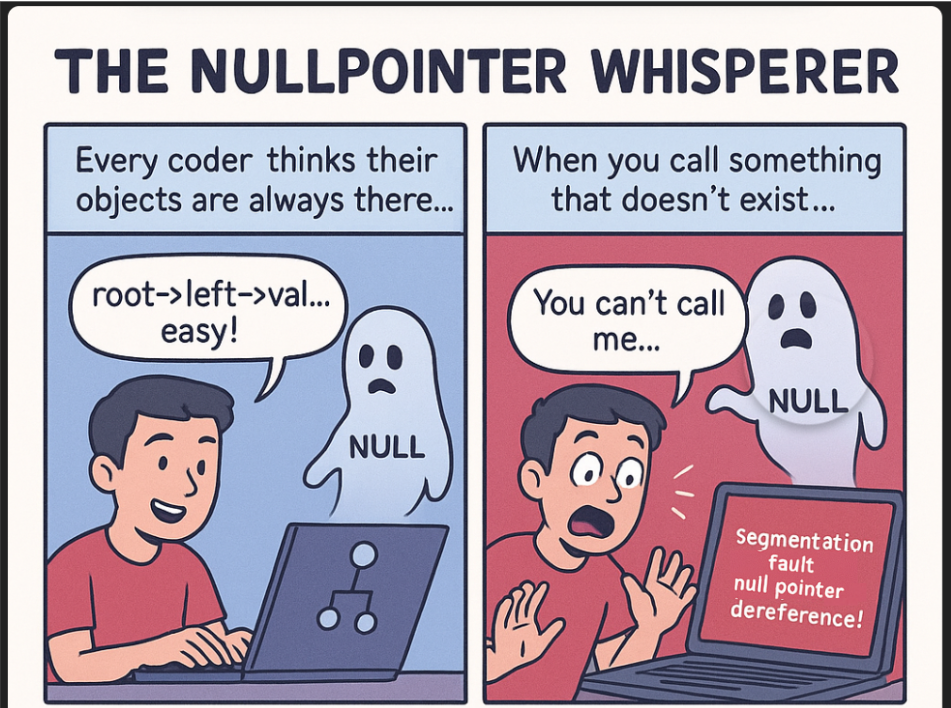 “You can’t call them… they’re null to you.” 👻📞
🧩 Problem
Everything works fine in your code…
until that one pointer you thought existed
turns out to be NULL.
A harmless access like:
root->left->val
suddenly becomes 💥 Segmentation fault (null pointer dereference). The silent killer of C++ beginners.
💻 Code Example (C++ with Binary Tree)
#include <iostream>
using namespace std;

struct Node {
    int val;
    Node* left;
    Node* right;

    Node(int v) : val(v), left(nullptr), right(nullptr) {}
};

int getLeftValue(Node* root) {
    // ❌ This will crash if root or root->left is NULL
    return root->left->val;
}

int safeGetLeftValue(Node* root) {
    // ⭐ Safe null checks
    if (root == nullptr) {
        cout << "Root is null!" << endl;
        return -1;
    }
    if (root->left == nullptr) {
        cout << "Left child is null!" << endl;
        return -1;
    }
    return root->left->val;
}

int main() {
    Node* root = new Node(10);

    // Left child not created → NULL
    cout << getLeftValue(root) << endl;
    // 💥 Segmentation fault (null pointer dereference)

    // Fix:
    root->left = new Node(20);
    cout << safeGetLeftValue(root) << endl; // ✔ Prints 20

    return 0;
}
Why this crashes
root->left->val tries to access .val on a nullptr.
It’s like trying to call someone whose phone is off: 📞 “Dialing left child…” 👻 Nobody is there to pick up — they’re null to you.
🌍 Real-World Connection
Null pointers aren’t just classroom errors. They break:
- Tree traversals in compilers
- Graph searches in game engines
- Database connection layers
- Microservices returning empty responses
- OS kernels handling missing resources
A single unexpected NULL can take down an entire application.
🛠 How It’s Solved in the Real World
-
Smart pointers (
unique_ptr,shared_ptr) Avoid raw pointers and get automatic lifetime management. -
Defensive programming Check before you dereference. Always.
-
Optional types
std::optional<T>in modern C++ helps you avoid “maybe-null” designs. -
Fail fast & log Production systems detect and trace null accesses early.
-
Safer languages Rust, Kotlin, Swift, and TypeScript use strict null safety at the compiler level.
⚡ Takeaway
A null pointer isn’t an error — it’s a reminder to respect object lifecycles and code defensively.
👉 Next time you dereference a pointer, ask: “Am I sure this exists?”
📅 Published: November 2025 ✍️ Author: Aisha Karigar