Comic 003 – The Off-by-One Apocalypse
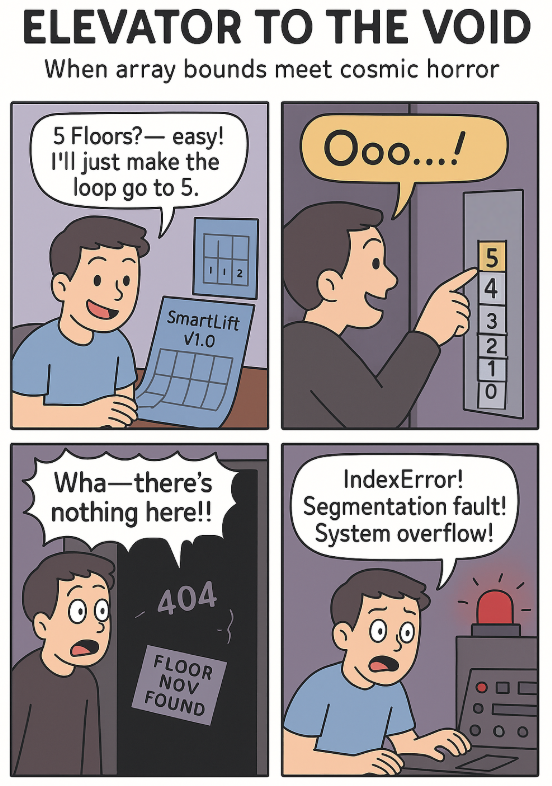
When your loop forgets where the top floor ends… 🛗💀
💥 Problem
Every developer’s first nemesis:
the off-by-one error — a tiny bug that opens doors to chaos.
Imagine an engineer programming an elevator for a building with floors 0 to n-1.
But instead of stopping there, they add a shiny “n” button —
one extra floor that doesn’t exist.
When someone presses it, the doors open…
to nothing. The elevator hangs in the void,
and the passenger screams:
“This wasn’t in the floor plan!” 😱
💻 Code Example (C++)
#include <iostream>
using namespace std;

int main() {
    int floors = 5;

    for (int i = 0; i <= floors; i++) {  // ⚠️ Off-by-one error!
        cout << "Stopping at floor " << i << endl;
    }

    cout << "Doors opening at floor " << floors << "...\n";
    cout << "Error: floor not found!\n";

    return 0;
}
💻 Code Example (Python)
floors = 5

for i in range(0, 6):  # ⚠️ Off-by-one error! range(0, 6) → runs 6 times
    print(f"Stopping at floor {i}")

print("Doors opening at floor 5...")
print("Error: floor not found!")
🧩 Lesson
The difference between < n and <= n decides whether you:
✅ stop safely within bounds — or
❌ overstep into an invalid range.
In most languages, arrays and loops start at 0
and end before reaching n.
That’s why your conditions should use < n — not <= n.
Rule of thumb:
Count starts at zero, but ends one step before n.
Miss that step, and your code will take one too many.
🌍 Real-World Connection
Off-by-one errors lurk in loops, pagination, date ranges, and even spacecraft code.
NASA once lost the Mars Climate Orbiter due to a tiny calculation error — proving that even one wrong boundary can send you miles off course.
In programming, one misplaced = can do the same.
Precision keeps your software — and your elevators — from falling apart. 😁
🦸 CodeLore
Our engineer wanted to make life easier — one extra floor, what could go wrong?
But the “n-th floor” didn’t exist. When the doors opened, the world did too.
“For i = 0; i <= n; i++ — and just like that, the elevator reached the end of reality.”
📅 Published: November 2025 ✍️ Author: Aisha Karigar