Comic 001 – Reverse Integer
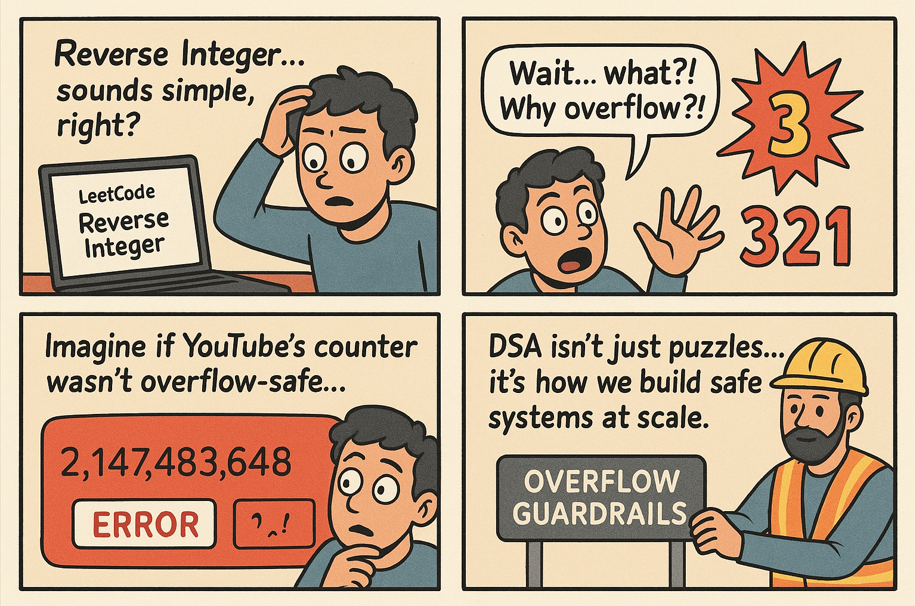 When your
 int can’t handle Gangnam Style 💃
🧩 Problem
On LeetCode, “Reverse Integer” looks simple:
👉 Take an integer, flip its digits, return the result.
But here’s the catch: what if the reversed number overflows a 32-bit integer?
💥 Suddenly, your program crashes.
💻 Code Example (C++)
#include <iostream>
#include <climits> // for INT_MAX and INT_MIN
using namespace std;

class Solution {
public:
    int reverse(int x) {
        int rev = 0;
        while (x != 0) {
            int digit = x % 10;
            x /= 10;

            // Check for overflow before multiplying by 10
            if (rev > INT_MAX / 10 || (rev == INT_MAX / 10 && digit > 7)) {
                return 0; // overflow
            }
            if (rev < INT_MIN / 10 || (rev == INT_MIN / 10 && digit < -8)) {
                return 0; // underflow
            }

            rev = rev * 10 + digit;
        }
        return rev;
    }
};

int main() {
    Solution s;
    cout << s.reverse(123) << endl;   // Output: 321
    cout << s.reverse(-123) << endl;  // Output: -321
    cout << s.reverse(120) << endl;   // Output: 21
    cout << s.reverse(1534236469) << endl; // Output: 0 (overflow)
    return 0;
}
🌍 Real-World Connection
Think of YouTube’s view counter.
Every time a video racks up millions of views, the counter increments.
But if the system isn’t overflow-safe…
➡️ 2 billion views could turn into negative views or break the counter.
This tiny puzzle reflects a massive engineering challenge:
- Handling edge cases at scale
- Designing systems that fail gracefully
- Thinking like an engineer, not just a coder
🛠 How It’s Solved in the Real World
Our code above works for LeetCode: if overflow happens, we just return 0.
But production systems don’t have that luxury.
-
Bigger data types
YouTube originally used a 32-bit signed integer for view counts (max2,147,483,647).
In 2014, Psy’s Gangnam Style broke this limit.
Solution? Upgrade to a 64-bit counter (max9,223,372,036,854,775,807). Problem solved (for now 😉). -
Even bigger numbers
In cryptography, finance, and scientific computing, numbers can exceed 64-bit.
Engineers use tools like GMP (GNU Multiple Precision) or even__int128in GCC/Clang. - Scaling / Approximation
Social platforms don’t show exact numbers past a point.- Backend stores the raw number safely (
long longor bigger). - Frontend shows a friendly version:
1.2Binstead of1,234,567,890. - Keeps the UI neat while data stays safe.
- Backend stores the raw number safely (
- Graceful handling
Instead of silently failing, production systems may:- Log the overflow
- Throw an exception
- Use fallback values
⚡ Takeaway
DSA isn’t just about algorithms. It’s about building systems that stand strong in the real world.
👉 Next time you solve a DSA problem, ask: “Where does this live in the real world?”
📅 Published: September 2025 ✍️ Author: Aisha Karigar